During the 1790s, Americans were divided between whether the United States should more closely align itself diplomatically with Britain or France. Federalists tended to favor Britain for cultural and economic reasons while Democratic-Republicans tended to prefer France. In 1798, amid growing tensions between the new French Republic and U.S., a diplomatic incident known as the XYZ Affair managed to outrage Americans enough to provide some political unity in opposition to France. The incident involved three American diplomats sent to France to negotiate an end to tensions in the hopes of avoiding war. Upon arrival, however, the French, saddled with ongoing war, demanded payment of money from America before the diplomats would be seen. Even to Francophiles, the French demands represented an affront to American sovereignty and resembled past British insults.
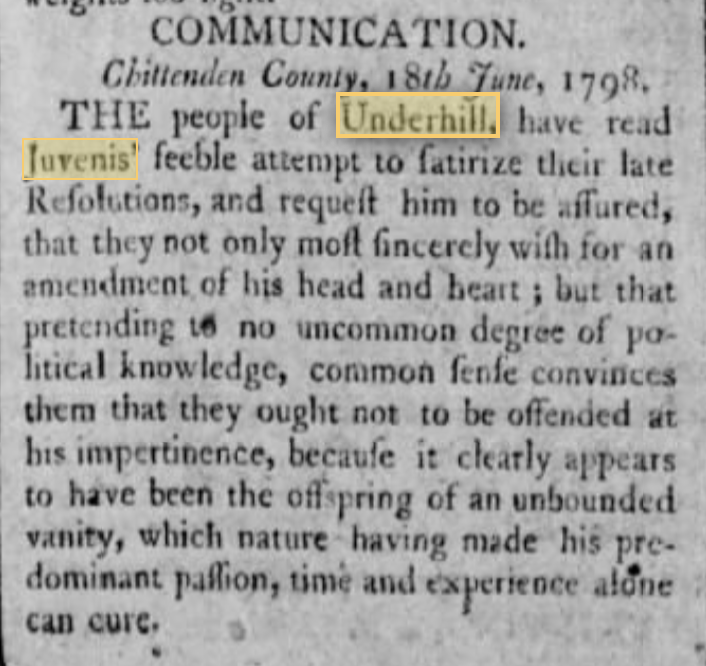
Many towns across America responded to the XYZ Affair with public statements against France.1 Underhill drafted its own response and published it widely, possibly in the hopes of eventually reaching readers in France through subsequent publications. The Underhill Resolutions offer a glimpse into the political thought during the town’s infancy and reveal a deeply connected community seeking involvement in national and even international politics. The text below has been transcribed from the May 25, 1798 edition of The Green Mountain Patriot of Peacham, VT.
Full text of the 1798 Underhill Resolutions:
The Green Mountain Patriot – May 25, 1798
For the Green Mountain Patriot. Messrs. Printers,
By giving the following a place in your paper, you will give an additional proof of your impartiality, and oblige U.H.
A number of the inhabitants of Underhill, in the State of Vermont, having met together for the purpose of reading with attention, and comparing their various sentiments on the late Dispatches from our Commissioners to the Republic of France; finding, on examination, that there was not in the whole town more than one man who was not a firm tried democrat, and perceiving, at the same time, that there was a perfect unison of opinion, requested the Selectmen to draw up such general Resolutions, maxims, or opinions, as they should deem most expressive of the universal sentiment of the whole town, to be exhibited to them, after divine service, on Wednesday the 9th of May, being the Fast day appointed by the President of the United States, and which, after Udney Hay was chosen to fill the Chair and William Barney was chosen clerk, were deliberately read, and afterwards read by paragraphs—fully explained—debated on—and, being in sundry instances corrected now stand as follows:
1st. We are of opinion that the British Treaty has produced the most discord amongst ourselves, and has been to the United States, the most pernicious instrument, to which their seal has ever been affixed, since they became one of the nations of the earth. That the whole tenor of it tended to create a jealousy in our only ally, nor does it in our opinion appear easy to conceive, how the unprejudiced and well informed mind could avoid discovering that France would take umbrage at some part thereof; a careful comparison of the 18th article of that treaty, with the 26th article of the treaty with France, taking into view the situation of all the parties at the time each of these treaties were formed, and knowing that every treaty we have entered into (that with Great Britain only excepted) contains a stipulation familiar to that in the 26th article with France, does alone fully justify us in our consciences for this declaration.
2d. That, so far from discovering pusillanimity, or timidity, it is equally honorable for a nation, as an individual, when sensible of having committed an error, openly to confess, and publicly to correct it.
3d. That the application of the term government, when the Executive Branch of that Government should only have been made use of, has misled many undesigning and well meaning men.
4th. That, while sensible to the necessary and propriety of each branch of Government maintaining all the powers legally bested in it, we are determined, that he who, either in contradiction to the Constitution, or by a strained construction thereof, endeavors to increase the Powers of the Executive, either positively or negatively, shall never have a vote from any of us as our Representative in Congress; fully convinced that, where a reasonable doubt arises on that subject, it is safer to place an excess of confidence in the hands of Congress, than in the hands of the Executive.
5th. That a Power lodged in the President, of forbidding, or permitting our merchant vessels, to arm, at his pleasure, would be extremely dangerous. For, if they have a natural right to arm in self defence, not forbidden by the Constitution, or law of the land, it is despotism in him to prevent them. If otherwise, we are of opinion that it is contradictory to the true meaning and inflection of the Constitution, that he should be insured with a power, which, though it does not amount to a declaration of war, must have a violent tendency to promote that greatest of all political calamities, a relinquishment of our Liberties or our Independence excepted.
6th. That the ruinous and distressed situation, into which a Pitt has brought the British nation, ought to be a warning to all people, enjoying the blessing of a representative government, never to let their fondness for a man or men, entice them to continue as their Rulers, any one of those, whose measures have been productive of the most alarming evils, which might have been avoided, in all human probability, by a contrary conduct, and may yet be in a great measure remedied by different men.
7th. That, if possible to be effected, it would prevent much discord, and render great service to the whole community, could some effectual mode be adopted for discriminating legally, between the liberty and licentiousness of the press.
8th. That this day in a particular manner, we esteem it a duty thus publicly to return our thanks, to the Ruler of the Universe, for the blessing of a general Constitution which we esteem the best on earth, and which, though not probably perfect in all its parts contains the seeds of amendment within its own bowels.
9th That, though we esteem the above points of very great general importance, as well as sundry others, respecting which our Representatives in Congress appear to form very contradictory opinions; we, nevertheless, hesitate not to declare, that our present alarming situation, arising from the arrogant and indecorous treatment our ministers have met with in France, calls on us loudly to lay aside, for the present, all thoughts of disquisition on those subjects, and, like true patriots, with a spirit of uninterrupted unanimity, turn our whole attention to the defence of our Rights, our Liberties, and our blood earned Independence. The mention of this produces in our hearts an instantaneous movement, for respectfully requesting our worthy Commissioners, to accept of our sincere, our hearty thanks, for their conspicuously meritorious conduct. May they meet with that reward, which to souls like theirs is the richest and most delicious of all earthly gifts—the universal approbation of their grateful fellow citizens.
While it is difficult to determine, whether they have shone most eminently in their display of firmness, or moderation, they have avoided every approach to meanness of humiliation. No national debasement, as on a former occasion, by an acknowledgment, “That the United States for reparation, have recourse only to the justice, authority and interposition of his Majesty.” No, brave men, you, like true Americans, declare that “one object was still dearer to us than the friendship of France, which was our national independence.” A speedy exportation from this happy country, without the benefit of return, to each citizen of the United States, who cannot from his heart, avow the same sentiment.
Tell us, worthy Commissioners, will you permit a few plain, undesigning, unlettered farmers, strangers to all cabinet intrigues, enjoying, seeking, or wishing for no office, to inform you how, was it in our power, we would, under present circumstances, address the French nation? We know that you will give your consent, for men, who can so happily intermix a true spirit of conciliation, with stern and rigid patriotism, are always polite and condescending. We will therefor begin:
Former Friends, Great and Illustrious Republicans, Brilliant Warriors, hitherto unconquered Soldiers, Frenchmen,
The foregoing resolutions will point out to you some of our general political maxims. We are convinced that, in many respects, they accord with yours. We have read with attention, with sorrow and surprise, the late Dispatches from our Ministers to the President, exhibiting the treatment they have met with from your government; a treatment, so degrading to the important station, which we are conscious, by proper management, our country must fill in the eye oof a discerning world; so disgraceful to these warm sentiments of admiration, your best friends, amongst us, have unremittingly displayed in your favor, so debasing to these expanded, generous, exalted declarations, your government, in its various changes, have constantly proclaimed, were and would be the rule of its actions; that we are utterly at a loss to conceive, what evil genius of France could have prompted your Directory to countenance measures, which, if not very soon retracted, must compel every American to withdraw his affection for you, unless he is deaf to the call of commanding patriotism, unless he is become perfectly callous to the cries of a despised, an insulted country. Gracious heaven! Can your Directory permit the men to breath, unpunished, the same air with themselves, who dared to tell our Commissioners that “they, (meaning this very Directory) disregarded the justice of our claims, and the reasoning with which we might support them.” Who degraded the most powerful nation on earth, by placing them on a level with the pirates of Barbary and savages of America. Who compared its first magistrates to a lawyer in the least honorable part of his profession. Judge, Frenchmen, what an opinion the world must entertain of them, if they treat such accusations with silence. Shall we add, men who had the effrontry to hint that, like Venice, we would, as a nation, be blotted out from the map of the world. But perhaps you will say, “We know how the Democrats of America have been abused; we have seen with what illiberal scurrility they have been wantonly reviled; we know that they will not miss this opportunity fully to revenge themselves of their bitterest enemies.” That a few Newspaper scriblers have abused us is certain, but ought that to prevent us from fulfilling our duty to our country? The great mass of Federalists, we can have no doubt, are in their views equally honest as we are, though we differ from them in some abstruse, while important political points—Many, many oof them detest, and despise the unmerited invectives which have been heaped on us, as much as we possibly can. In this State, we could produce a lengthy catalogue of names, in support of this assertion. We shall mention two—a Tichenor and a Hitchcock. Who, that is well acquainted with them ever entertained a doubt of their moral virtue? Or their political honesty? Who, in their most convivial hours, ever heard either of them revile any man, or body of men, merely on account of a disagreement from them on certain political tenets, however strenuous they might be in support of ttheir own opinion. At any rate, Frenchmen, we rely fully on the good sense of our countrymen at large, for determining on the propriety or impropriety of our maxims and sentiments, that being the only tribunal before whom we will ever permit ourselves to be judged on that particular point. Think not from this, that we are such cowards and dastards, or even so meek and gentle, as to forget that we hvae been unmeritedly termed “disorganizers”—“traitors to our country”—“men who were aiming to overset our government”—and by way of ridicule “exclusive patriots,” &c. &c.—Or, that we will deprive ourselves from all the pleasures attendant on honorable resentment. No, Frenchmen, we will glut ourselves with revenge; we will overwhelm our enemies with shame, and bury them in penitential sorrow. We will, if attacked by you, be the foremost in flying to the standard of our insulted country, and inflict immediate vengeance on all such of our present revilers as shall not have virtue enough instantly to follow us. We will compel the whole of them to declare, that it is difficult to discriminate betwixt Democratic revenge and Patriotic magnanimity.
Forget not, Brilliant Warriors, that a small band of United Freemen; a small band of men, who have outvied each other in demonstrating their regard for you, and your country; who have resented every appearance of an injury against their beloved ally, with an enthusiastic ardor approaching almost to error, in thus revealing to you their own sentiments, disclose, at the same time, those of their democratic brethren, throughout the United States. Actuated by the purest, the most disinterested motives, we separated ourselves, in a certain degree, from the administrators of our government, because we believed that they wished an unnatural connexion with our former, and your then most powerful and most vindictive enemy. Because we believed that they neither discovered, nor felt all that energy of Friendship for you, which the glorious cause you was engaged in so justly merited. What return have we lately received for these vigorous proofs of our unqualified friendship? Our messengers of peace have, for upwards of three months, in a mode bordering on humiliating concession, been praying to be heard, for the express purpose of renewing on the most firm and permanent basis, a friendship extremely interesting to both nations. Think how our hearts are agitated, from being obliged to add, that, during the whole of this time, they have been permitted to remain unaccredited. Your Directory have even refused to open the door of reconciliation; they have refused to grant, to their tried friends in this country, the means of discovering, whether the administrators of their government were sincere in their asserted desire of a renewal of that love and friendship, which once so happily subsisted between us. They have [illegible] equally, the opportunity of making reparations for injuries committed, as of defending our country against accusations, some of which, at least, upon fair and impartial investigation, might possibly be either totally disproved, or greatly palliated. Lay your hands on your hearts, Brilliant Warriors, you have offered such astonishing proofs of your enthusiastic bravery, in defence of the honor of your country, and say, what your feelings would have been, had Ministers of yours, sent for the same laudable purpose, been treated with such deliberate disrespect, such disdainful contempt. We wait not for an answer, we know by our own feeling what yours would be on such a trying occasion.
Permit us, Frenchmen, in the sincerity of remaining friendship, to assure you, that in attacking this country, you will have difficulties to struggle with, inexperienced hitherto in the defence of your own, or in the conquest of others. Nature has given us strong holds innumerable. Providence has impressed our minds with an enthusiastic thrift to preserve our Independence. While yet untutored in the art of war, the capture of a British army proclaimed to the world the firmness of our zeal, in the maintenance of our rights and privileges. That zeal, you will find upon trial, not in the least, yes we repeat it, not in the least, diminished. Your valiant countrymen, who freely and gallantly shed their blood in aiding us to capture a second British army, will tell you that our natural courage is not inferior to yours; that in marching and countermarching, and in preparing places of temporary defence, we are capable of exceeding you.
Animated as we then shall be, on parting from our wives and children, from our brothers and sisters, from our nearest and dearest connexions, by an endearing embrace, a heart felt sigh, and above all by the remembrance, in the hour of action, of that to them heart rending admonition, which however they will not fail to give to us at the moment of separation “let victory or death be your constant countersign.” We will be more than a match for you. Recollect the immortal glory your army gained at the battle of Genappe. Recollect the sentiments by which they were then inspired, by which they were led to victory and success. Recollect that in a contest with you, we shall b e fighting in the same cause as they then were; and you will not ascribe our assertion to a heated imagination, or a spirit of gasconading; you have already proved it from experience to be a well founded truth. Recollect, we beseech you, the general events of your contests while you were slaves, with the powers you have lately conquered, or the one you are yet engaged against, and contrast them with your unequalled successes, since you became freemen. Recollect that we are free, as you can wish to be, and that you must not measure your expected success against us, by what you have experienced in your contest with the enslaved Austrian, or the enslaved Italian. We assure you, in the name of former friendship, a friendship which we sincerely lament has ever been in any degree lessened; a friendship which, with equal sincerity, we most ardently wish may be yet speedily and firmly renewed; that, whenever any nation under Heaven attacks the Territory of the United States, the universal song will be in the plain, but expressive language of the sailor, “a long pull, a strong pull, and a pull all together.” It will be a pull, if you compell us to face it, which astonished and applauding nations will read the accounts of with admiration; which angels and the spirits of our many departed heroes will look down on with approbation; and which Heaven will finally crown with success.
But let us, once dear and much valued friends, enter for a moment into the field of improbability, and admit that you would eventually prove successful against us. Can you possibly, even in that case, gain as much as you would by an equitable and amicable settlement of existing differences? Peace established in Europe, you bid fair for soon becoming the first mercantile nation in the Universe. Your climate far superior to that of Britain; your soil at least equally good; your position, on a rich and extended continent, affording you great advantages over her insulated situation; purged of that herd of drones the late Nobility of your country; divested of that ignoble prejudice, which prevented men of rank, fortune, or family, from pursuing any profession, art, or occupation; with minds possessing the most inventive faculties, all the various branches of commerce and manufactures must progress and flourish amongst you, with a degree of rapidity, exceeding even your own expectation. To support this productive parent of finance, from whom are you to obtain the raw materials? From whom are you to obtain the necessary supplies of provisions lumber &c. for your rich West India possessions? Nature in both instances has pointed out the United States. It must then upon due consideration, be your and our wishes, because it is your and our Interest, that the friendly hand of nature should on the head, meet with our mutual assistance. We earnestly request of you to consider this well, before you adopt such measures as must thwart, perhaps for ever, this pleasing prospect, by driving our trade into other channels, from which it may never again be possible to divert it. In short, before the fatal die is finally cast, which might, which probably would divide us for ever, we will remind you of the illustrious declaration of your Executive, in their note of the 4th of January 1793, in answer to the arrogant language of the British Minister: “After having done every thing in our power to maintain peace, we will prepare for war, conscious at least of the justice our our cause, and of the efforts we have made tto avoid that extremity. We shall combat, with regret, the English whom we esteem, but we shall combat them without fear.” This was language worthy of an infant Republic, conscious of its own greatness.
Permit us to observe thereon, that if our Ministers cannot get accredited; if your government will not consent, officially, to propose terms, nor, officially, to hearken to propositions, of accomodation, we will imitate an example we have long admired, and a similar declaration to your Directory, the instant Congress issues the order, will be the favorite theme of every democrat, from the southernmost bounds of Georgia, to the northernmost line of Vermont.
The Clerk was then ordered to add pursuant to a motion for that purpose, that every paragraph of the above had been unanimously agreed to, and the Chairman was in like manner desired to have the whole printed, in one or more of the Vermont public papers.
By order of the meeting,
Udney Hay, Chairman
William Barney, Clerk2
 Underhill Historical Society